How to Pre-Order the Fitbit Edge, Available October 27
Google's Fitbit Edge launches October 27 at $179.99. Pre-orders are open now in multiple colors with optional band upgrades.
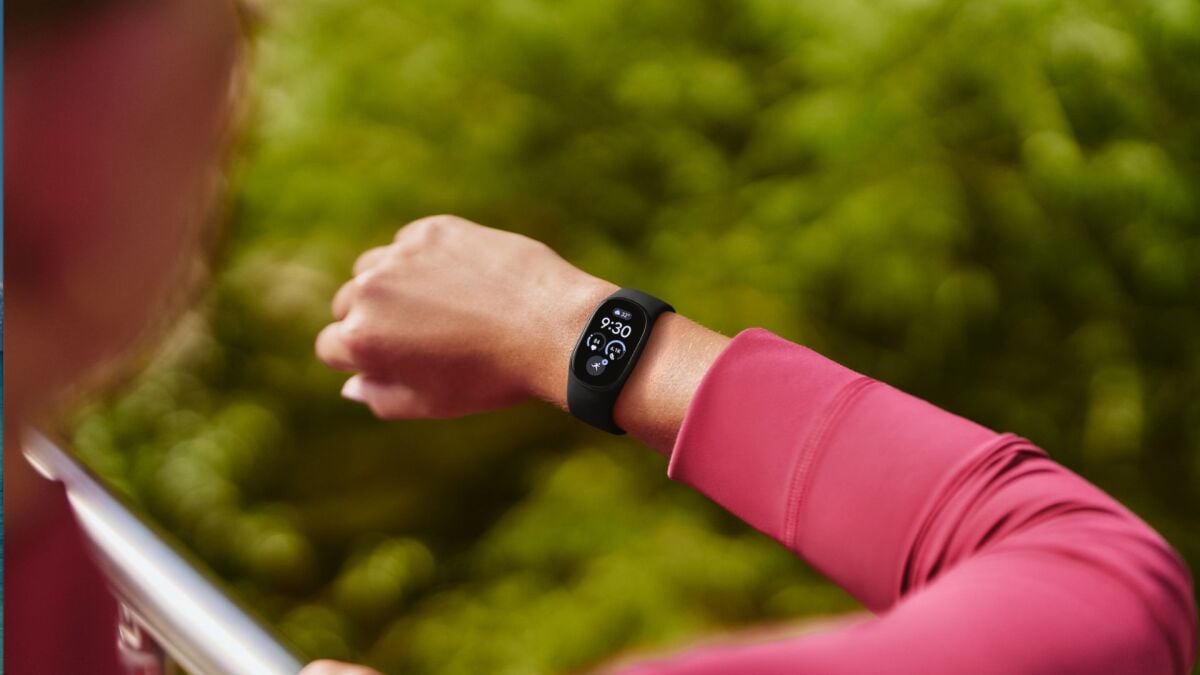

Credit: Google
We may earn a commission from links on this page.
Google announced the Fitbit Edge earlier this week, making it the company’s first Fitbit with a screen since the Charge 6 was released in 2023. Pre-orders are open now, and the devices are expected to start shipping on Oct. 27.
The Fitbit Edge ($179.99) has features and a price that fall right in between the Fitbit Air, which has no screen and retails for $99.99, and the Pixel Watch 5, a full-featured smartwatch that starts at $399.99.
You can pre-order the Fitbit Edge here. It comes in black with a black band, silver with a “fog” (gray) band, “champagne gold” with a salmon-pink band, and a metallic color called “satin pyrite” with an olive green band. There’s also a Steph Curry edition for $219.99 in gray and orange. The standard packages come with two bands: a small/medium that fits wrists 130 to 170 millimeters around, and a medium/large for wrists 170 to 210 millimeters. Additional bands are available for an extra fee: an “active sport” band with larger holes for ventilation ($39.99), a magnetic band ($49.99), and a band with metal links ($149.99).
What’s New in the Fitbit Edge
Unlike the screenless Fitbit Air, the Fitbit Edge adds its own GPS chipset, so you can track distance without bringing your phone, and an altimeter to detect elevation changes like hills. The altimeter also enables a “floors climbed” metric each day. The Fitbit Edge also includes an ECG app, a morning report, and the ability to control music playing on your phone regardless of which app is playing it.
If you’re upgrading from a Fitbit Charge 6, the Edge adds an altimeter and a morning report, and the music controls now work with any music app, not just YouTube Music. The Edge is missing some features, however: with no NFC, it can’t do tap-to-pay with Google Wallet. Google Maps directions are also absent at launch, though Google says they are coming soon. The EDA scan and stress tracking have been removed as well — a reasonable trade-off, given that stress tracking isn’t accurate enough to be useful.