GrapheneOS Is Coming to Motorola Phones in 2027
GrapheneOS is partnering with Motorola to expand beyond Pixel phones. Motorola's 2027 slab lineup will be the first to qualify.
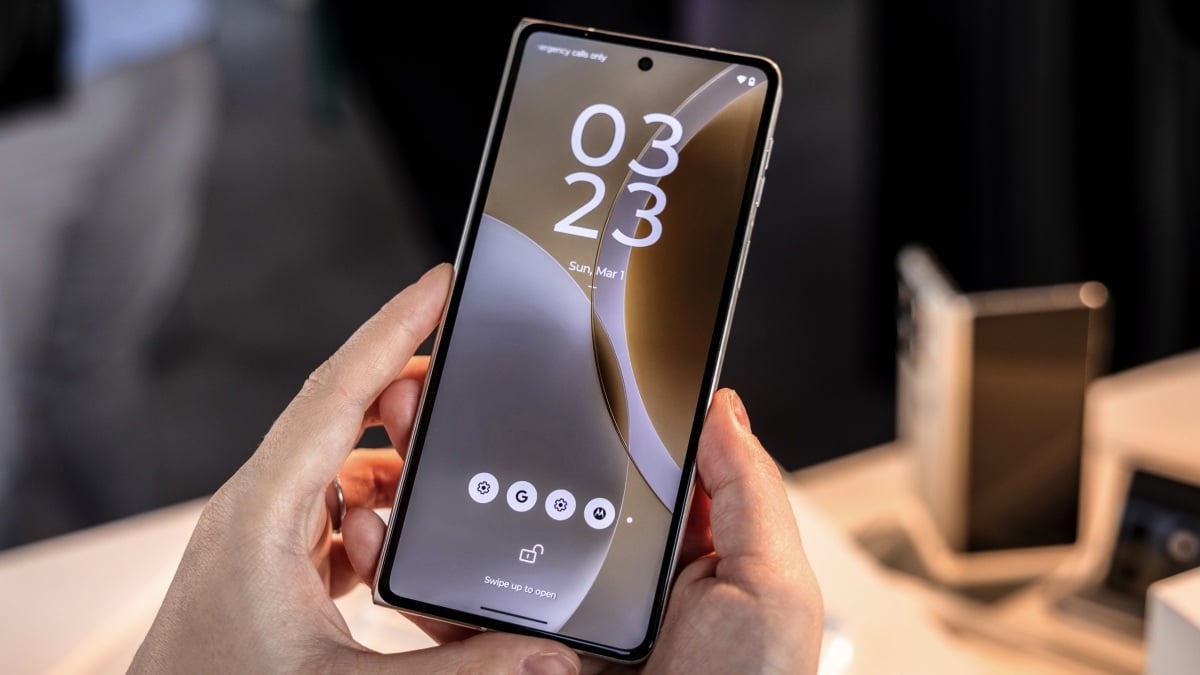

Credit: Angel Garcia/Bloomberg via Getty Images
Key Takeaways
- GrapheneOS is working with Motorola to bring the privacy and security OS to more smartphones.
- The company shared updates in its partnership, announcing that Motorola’s 2027 lineup would be the first to receive support.
- GrapheneOS says that these will be Motorola’s first phones that meet all security requirements, though the company will only support its “slab” phones at first.
- GrapheneOS is also working on adding support for Motorola’s foldable and flippable phones, as well as the 11th-generation Pixel devices.
Many of us don’t think twice about the OS our smartphones are running. On the surface, it really seems like there are only two options: iOS, for those of us with iPhones, and Android, for all other phones. But the conversation is much more nuanced than that: Many non-Apple smartphone manufacturers have their own takes on Android that make for a slightly different experience. Samsung has One UI, OnePlus has OxygenOS, and Nothing has Nothing OS, for example. (Pixel ships with stock Android, as Google makes both the hardware and the software.)
However, the mobile OS rabbit hole goes even deeper. If you’re particularly technical (and you don’t have an iPhone) you can install a new OS on your smartphone to give you added control or features you won’t find on Android. GrapheneOS just so happens to be one of those custom OSes, and its list of supported devices is about to grow.
GrapheneOS is an open-source mobile OS designed with privacy and security in mind. While the OS is built on the Android Open Source Project, it employs a number of privacy and security features to both thwart common security vulnerabilities and block invasive trackers from scraping your data. Because it’s built on Android, it supports Android apps, but won’t include Google apps or services by default. It won’t block Google Play outright, however: Users can choose to install Google Play in a “sandbox,” which limits the elements of your phone Google’s apps and services can access.
Crucially, GrapheneOS has a long list of requirements manufacturers must meet before it decides to support new devices. Some of those key prerequisites include the ability to run alternate OSes with full hardware security access, commitments for at least five years of updates, secure element integration, and hardware memory tagging, among many others. If you want to run this custom OS that prioritizes privacy and security, you either need to pick your new smartphone carefully, or hope your preferred manufacturer creates a device in the future that meets these specifications.
GrapheneOS Is Coming to Motorola Phones Next Year
As of this writing, only Google’s Pixel phones currently support GrapheneOS—though GrapheneOS doesn’t necessarily recommend using all supported Pixels at this time. The OS will run on Pixel 6 and newer (minus Pixel 11), but GrapheneOS recommends at least Pixel 8 or newer, because of Google’s minimum seven-year support commitment and Pixel 8’s hardware memory tagging.
However, Pixels won’t be the exclusive choice for GrapheneOS for long. The OS maker has been working with Motorola to bring support to its phones. As reported by The Verge, GrapheneOS recently announced some key updates on this front. Motorola’s 2027 lineup of “slab” phones (non-folding, in other words) are currently planned to be the first to support GrapheneOS, with support for Qualcomm’s upcoming Snapdragon 8 Elite chips. GrapheneOS explained its reasoning in a Mastodon thread: It says that Motorola’s current-generation phones, including the Motorola Signature, Razr Fold, and Razr Ultra, “are very close” to meeting its security requirements, but are missing some crucial features coming to the 2027 lineup, including adequate secure element integration.
GrapheneOS also emphasizes its enthusiasm for Snapdragon chips, which it says provide better CPU and GPU performance as well as isolated components (such as cellular, Wi-Fi, and Bluetooth), compared to Google’s proprietary Tensor chip. GrapheneOS says that Tensor has been a “sidegrade or downgrade” from Snapdragon in many ways, but came with security advantages that Snapdragon hasn’t caught up to yet—though that now appears to be changing. While GrapheneOS has found it harder to work with Pixel in recent years, the company says that Motorola has done much of the work in bringing GrapheneOS to its devices, which is an encouraging sign that the OS should be well-optimized for Motorola hardware when it arrives.
GrapheneOS says it plans to support Motorola’s foldable and flippable phones as well. The company already supports the Pixel Fold, Pixel 9 Pro Fold, and Pixel 10 Pro Fold, so the foldable form factor is nothing new—however, a flip phone represents a new design category for the project. In addition, GrapheneOS is working on support for the 11th-generation Pixel devices, meaning the platform’s reach is set to expand significantly across both manufacturers in the coming years.